Whether in MMA, point sparring, or a realstic altercaton, it makes no difference, the jab is the most effective combat technique to date. Unfortunately, very few mrtial artists know how to take full advantage of it's many uses. What follows is a comprehensive explantion and illustration of both why the jab should be used and for what purposes. First, I'll explain the many advantages a well developed jab has over other combat techniques. In other words, why you should develop a strong jab.
The jab, or forward hand strike, as some call it, is the closest weapon to the target when fired form a strong defensive position. This means it has the shortest amount of distance to cover from its starting point to the point of pressure (moment of impact against the target) and consequently, the shortest amount of distance as it travels back, allowing the exocutioner a minimal amount of time between strong defesnive positions. When thrown correctly, the hand should extend and cover the face of the executioner when viewed from a linear perspective, providing good defense throughout the technique's execution.
The jab moves directly to the target in a linear fashion. In geometry, it is stated that the shortest distance between two points is a straight line. This principle, applied to combat, significanly shortens the distance a technique must travel before reaching the target and, therefor, the distance it must travel back. In combat, only two things can be ganed aganst an opponent: distance and time. The jab enables the executioner to gain both.
Due to the natural mechanics of the human body, the human's natural use of the hands, and the two principles mentioned above, the jab is the fastest technique known to man. Speed is one of the hardest attributes to overcome in an opponent. Truly explosive fighters have always lerned to develop an explosively quick, stinging jab that allows them to blister and frustrte their opponent while not slugging it out toe to toe with them. I will discuss this in more detail when we analize the many purposes of the jab.
The jab, or forward hand strike, as it will be more appropriately refered to in this instance, has the largest "window of opportunity" of any technique. This means there are more ways of executing the jab as a direct technique as well as a number of target areas and purposes it may be applied to. The forward hand strike may be used as a finger jab, for street altercations, a trdditional boxer's jab, a backfist, a ridge hand, or open hand obstruction. There are limitless angles the forward hand strike may utalize, as illustrated by the difference between the boxer's jab and the backfist. Target opportunities as well are both limitless and directly relted to the intended purpose of the strike. It may be used to strike the head, neck, body, or hands. I have even seen it used to strike the knee area.
Combat is a deffensive endeavor. This means you must establish a strong defensive gameplan before effectively using offensive strategy. Along with control of distance, the most important defensive principle is maintaining a strong defensive position or stance. This means you should give your opponent as little center line as possible, weight should be evenly distributed over each foot, allowing you freedom of movement by way of effective footwork, your hands should be up by your cheek bones, and your elbows should stay close to your rib cage. Any offensive movement requires a temporary compromise of this position and the practitioner should keep that compromise as small as possible. The sooner the prctitioner can retract the weapon, the sooner this defensive position can be reestablished and the safer the practitioner will be. This principle is known as "recovery time". A failure to demonstrte good recovery time results in "hang time", a gap in offensive timing caused by the split second delay in retracting the weapon after the technique is extended. Good counter fighters look for this mistake nd capitlize on it. Because an effective jab moves directly to the target from a position closest to the target, it allows the smallest compromise in defensive positioning and quickest recovery time of any technique there is.
Understanding now, the advantage the jab has over other techniques, we will look at it's many uses.
An effective jab is one that, first and formost, stabalizes the target. This allows the executioner to impliment one of the cardinal rules of combat: "always neutrlize your opponents position, offense, and advantages". A good jab is a sudden, explosive relese of confined energy straight into the intended target. By putting your opponents attention on the stinging jab or on defending against the jab, you have stabalized him for a power shot. And by stabalizing the target, you have nullified your opponent's ability to do damage at that moment.
An effective jab is one that is used to set up an opponent. The jab, when well placed and executed repetedly with authority, causes an opponent to give in to his mind's eye. As you continue to score the jab, your opponent will begin to anticipate it as he tries to read your bady movement. At this point, he is thinking in the future tense and a good fighter can fake a jab to one area of the body and complete the technique or surprise attack to another ungaurded area. A good fighter can also complete the jab, as expected, but double or tripple up on it or execute additional strikes behind it. In a smilar fashion, the jab can be used to disrupt the strong defensive posture of an opponent who's mind is in the future tense. You can fake low to bring his guard down and execute high, or vise versa. This is called "The high, low principle".
An effective jab is one that can be used to close the gap. The most importnt manuver in combat is to explosively close the gap between you and your opponent without him repositioning or hitting you on the way in. This is especially true for short fighters, such as myself. The execution of a jab begins withthe non-telegrphic movement of the hand. This is called "independant motion" and helps prevent your opponent from spotting your initial move. As your jab extends to stabalize the target, thus preventing him from repositioning or firing back, you must step in behind it. This step not only adds power to all techniques, but effectively closes the gap on your opponent. Now your are close enough to execute your prefered method of attack.
And effective jab is one that allows the executioner to effectively guage distance. This is especially true for kickers and grapplers. As stated before, all techniques temporaraly compromise your defensive positioning, some more than others. Kicks require you to stand on one leg, compromising balance while exposing more target areas, whereas a takedown requires you to advance your target area straight towards your opponent's weapons. To incorrectly judge the distance needed to execute either type of attack would mean getting hit or taken down yourself. Because the jab requires a minimal compromise in defensive positioning and moves directly towrds the target, it is the idel technique for gauging the distance required for a kick or takedown.
An effective jab is one that allows the executioner to gauge the defensive or offensive counter reaction of one's opponent. If you are unsure of which techniques or angles of attack to utalize against a respective opponent, sting them with a few quick jabs. This will expose both a fighters defensive and counter offensive game plan as well as their weaknesses. Landing constant jabs on your opponent will frustrate him and frustrated fighters tense up and begin to make mistakes where they are weakest.
An effective jab is one that allows the executioner to blind his opponent. This can be done in several ways, the first and most obvious being the action of obstructing your opponent's vision and concentrtion by putting your hand in his face. You can also make your opponent blink, cut him so that the blood runs down into his eyes, cause his eyes to swell shut, or hit him in the nose, causing his eyes to water.
An effective jab is one that allows the executioner to turn the opponent. One of the key strtgies in combat is to control your opponent's set point. Being "set" primarily means three things: (1)Attaining the correct distance (2) Attaining the correct alignment (3) Being ready to fire. Taking away one or more of these three things will prevent your opponent from being able to launch an effective offensive movement against you. One of the best ways to take away your opponent's alignment is to physically turn him with both your footwork and technique. By physically turning your opponent's head or body from one side to the other, so that he loses both his alignment and aim (part of being ready) allows you to control his set point, thereby neutralizing his postion as well as any advantage he may have. Using your jab to strike your opponent in the neck or behind the jaw is an excellent way to do this. It also opens up more target areas to attack. One good example is to use an oppen hand obstruction against your opponent's forward shoulder, squaring his hips towards you, exposing his center line, and placing him off balance for a takedown.
An effective jab is one that allows you to back your opponent up. Against larger opponents or pressure fighters, this is a key strtegy if you wish to conserve energy and avoid being cornered or having the ring cut off against you. Striking your opponent between set points with an explosive, authoritative jab will cause him to place his weight back on his heels and possible straighten his knees out. When this happens, size makes no difference, you can back him up and even knock him down with your power shots.
And effective jab is one that allows the executioner to effectively displace the lead hand of the opponent, neutralizing it's use for offense and create an oppening for a follow up strike. This is similar to trapping techniques. A jab can be thrown against your opponent's defensively postured hand to pat it down, obstructing his offense and creating an oppening. You can also strike the forearm of elbow, trapping the opponent's arm against his own body for a brief moment, allowing you to strike. Be sure to follow up instantly.
And effective jab is one that the executioner may use as a defensive tool. Although slipping, shoulder and body rolls, leg checks, and sprawls are a must, a good jab can be used in their place. As you control your opponent's set point (distance, alignment, and readiness), you keep him from acquiring the position he needs to fire against you. If your opponent executes, for example, a hard leg kick, normally you would check it. However, should your opponent attempt to execute the leg kick, explosively step in as your opponent hits the set point and readies himself to torque the hips and fire the kick. As you step inside his knee, land a double jab to his face and explode back out. What happened to the kick? You neutralized it. The same can be done against any technique.
The old saying is "if you can't jab, you can't fight". In effect, this is true. However, those who can execute an explosive, authoritative, and educated jab, can fight very, very well. How effective is your jab?
Monday, May 2, 2011

Saturday, April 23, 2011
10 Greatest Fighters of the 20th Century
Who are the ten greatest fghters of the past century? That's a question that can only be answered subjectively, of course, but let's take a shot at it. There are quite a few things to consider, including but not limited to athletic ability, ring craft and craftiness, technique skills, courage, performance under pressure, adaptability, creativity, innovation, influence, guts, and most of all, heart. With those qualities in mind, I have narrowed the selection down and chosen my top ten. Here it is, as I see it!
(10) Huo Yuanjia

A small chinese Kung Fu master who preached the importance of blending martial arts styles, defeating all challengers who tried to stop him from teaching the martial arts to Westerners. Did I just describe Bruce Lee, maybe, but Huo Yuanjia actually did all of that first. In fact, you could call him the first mixed martial artist of the 20th century. With a passion for sharing information when most teachers hid it, Huo Yuanjia put a price on his head and, according to many historians, was eventually poisoned. But not before he beat multitudes of foreign challengers at their own games, even in death matches! That's one bad little dude!
(9) Jack Dempsy
(8) Chuck Norris
 Interestingly, Chuck Norris is the only fighter on this list who never participated in continuous full contact bouts. He was a point fighter, but his fights were in the blood and guts days where points were scored when one contestant hit or kicked another while barefoot and barefisted. And Norris was the point fighting king of the blood and guts days. He innovated combinations in martial arts matches and had a reputation for being a very sneaky opponent. His biggest advantage though, was simple....he's Chuck Norris!
(7) Jack Johnson
 Long, lean, technical, and unforgivably black, Jack Johnson made quite an impact when he dismantled what was, at the time, the white man's sport. No black fighter had ever won the heavyweight boxing crown and Jack Johnson took it as if none of his opponents had ever boxed before. He made really good fighters look incredibly bad. He was loud and cocky, even taunting his opponents in the ring as he toyed with them before beating them sensless. Remind you of anyone? He was one of the greatest fighters of all time for sure and brought a lot of technical skill to the game that it didn't have before. Sugar Ray Leonards and Anderson Silvas would not exist without Jack Johnson.
(6) Benny Urquidez
 Benny "The Jet" Urquidez might be the most gutsy fighter to ever step foot in the ring. He was small but he was one of the most well rounded and adaptable fighters to ever live, beating men who were larger, stronger, faster, younger, and more experienced. But best of all, he did it all under their own rules, in there own hometowns, and he did it 58 times in a row! Forget your UFC five fight "winning streak", show me a 58 fight winning streak and then I'll be impressed!
(5) Joe Louis

Joe Louis is a legend among fighters of all styles and eras. He had what we call the "it" factor. He was smooth, methodical, and had some of the best power in the fight game. His up and over combination (uppercut/hook) alone was jaw dropping or in the case of his opponents, jaw breakng. The guy could do something that most fighters can't and that is recognize your advantage, neutralize it, exploit your weakness, and take you apart. He had an impressive 25 tittle defenses and is the longest raining champion in boxing history. he's also an American hero for taking apart Max Schmelling, the Nazi poster boy who Hitler personally claimed would show superiority to Americans, specfically black Americans. How could you not love a guy who beats the crap out of Nazis.
(4) Joe Lewis

Big, strong, fast, pwerfull, mean, confident, and technically superior, Joe Lewis was the total package that everyone in the fight game was afraid of. He beat the crap out of everyone! This was during the blood and guts days of Karate too, where you fought with bare knuckles. Lewis also pioneered full contact martial arts in America and became it's first champion with ten first round knockouts. He also studied with Bruce Lee and showcased his techniques and philosophies to perfection.
(3) Sugar Ray Robinson
 Sugar Ray Robinson sums up what it means to be the pound for pound best in the world. Sugar Ray Robinson was as good as any fighter in history, from the combat games of Ancient Greece to today's mixed martial arts scene. With unmatched hand and foot speed in his devision, brilliant ring craft, and incredible heart, there are only a handful of fighters that can compare with the original Sugar Ray. Just check out his five fight rivalry with Jake Lamotta and you will know what I mean. Sugar Ray could fight , dog!
(2) Bill "Superfoot" Wallace

Bill Wallace is really something. He had techniques that looked like they came straight from Hollywood, only better and more devistating. He could kick at 70mph and throw as many as five or seven kicks without touching his foot to the ground. There are lots of guys who can do the later part for show, but Wallace was the only one who could do it to the best fighters in the world as they were trying to kill him! In addition to that, Wallace was a fighter that no one could ever really figure out. Somehow he always eluded everyone's game plan and always had something you couldn't quite see until you were in the ring with him. "Superfoot" had 23 professinal kickboxing bouts and won them all, retiring as the only undefeated Full Contact World Champion in American martial arts.
(1) Muhammad Ali
(10) Huo Yuanjia
A small chinese Kung Fu master who preached the importance of blending martial arts styles, defeating all challengers who tried to stop him from teaching the martial arts to Westerners. Did I just describe Bruce Lee, maybe, but Huo Yuanjia actually did all of that first. In fact, you could call him the first mixed martial artist of the 20th century. With a passion for sharing information when most teachers hid it, Huo Yuanjia put a price on his head and, according to many historians, was eventually poisoned. But not before he beat multitudes of foreign challengers at their own games, even in death matches! That's one bad little dude!
(9) Jack Dempsy
If I could pick a top three fighters to have on my side in a fight for my life, Jack Dempsy would be one of them. He defined the word "toughness". And he was as men as they come. When Dempsy fought six-feet six monster Jess Willard for the tittle, he broke multiple bones in his face and ribs before putting him down for the count. Dempsy also had incredible power through body mechanics, earning him a still stnding record fo 25 first round knockouts! That's scarry!

(8) Chuck Norris
Interestingly, Chuck Norris is the only fighter on this list who never participated in continuous full contact bouts. He was a point fighter, but his fights were in the blood and guts days where points were scored when one contestant hit or kicked another while barefoot and barefisted. And Norris was the point fighting king of the blood and guts days. He innovated combinations in martial arts matches and had a reputation for being a very sneaky opponent. His biggest advantage though, was simple....he's Chuck Norris!(7) Jack Johnson
Long, lean, technical, and unforgivably black, Jack Johnson made quite an impact when he dismantled what was, at the time, the white man's sport. No black fighter had ever won the heavyweight boxing crown and Jack Johnson took it as if none of his opponents had ever boxed before. He made really good fighters look incredibly bad. He was loud and cocky, even taunting his opponents in the ring as he toyed with them before beating them sensless. Remind you of anyone? He was one of the greatest fighters of all time for sure and brought a lot of technical skill to the game that it didn't have before. Sugar Ray Leonards and Anderson Silvas would not exist without Jack Johnson.(6) Benny Urquidez
Benny "The Jet" Urquidez might be the most gutsy fighter to ever step foot in the ring. He was small but he was one of the most well rounded and adaptable fighters to ever live, beating men who were larger, stronger, faster, younger, and more experienced. But best of all, he did it all under their own rules, in there own hometowns, and he did it 58 times in a row! Forget your UFC five fight "winning streak", show me a 58 fight winning streak and then I'll be impressed!(5) Joe Louis
Joe Louis is a legend among fighters of all styles and eras. He had what we call the "it" factor. He was smooth, methodical, and had some of the best power in the fight game. His up and over combination (uppercut/hook) alone was jaw dropping or in the case of his opponents, jaw breakng. The guy could do something that most fighters can't and that is recognize your advantage, neutralize it, exploit your weakness, and take you apart. He had an impressive 25 tittle defenses and is the longest raining champion in boxing history. he's also an American hero for taking apart Max Schmelling, the Nazi poster boy who Hitler personally claimed would show superiority to Americans, specfically black Americans. How could you not love a guy who beats the crap out of Nazis.
(4) Joe Lewis
Big, strong, fast, pwerfull, mean, confident, and technically superior, Joe Lewis was the total package that everyone in the fight game was afraid of. He beat the crap out of everyone! This was during the blood and guts days of Karate too, where you fought with bare knuckles. Lewis also pioneered full contact martial arts in America and became it's first champion with ten first round knockouts. He also studied with Bruce Lee and showcased his techniques and philosophies to perfection.
(3) Sugar Ray Robinson
Sugar Ray Robinson sums up what it means to be the pound for pound best in the world. Sugar Ray Robinson was as good as any fighter in history, from the combat games of Ancient Greece to today's mixed martial arts scene. With unmatched hand and foot speed in his devision, brilliant ring craft, and incredible heart, there are only a handful of fighters that can compare with the original Sugar Ray. Just check out his five fight rivalry with Jake Lamotta and you will know what I mean. Sugar Ray could fight , dog!(2) Bill "Superfoot" Wallace
Bill Wallace is really something. He had techniques that looked like they came straight from Hollywood, only better and more devistating. He could kick at 70mph and throw as many as five or seven kicks without touching his foot to the ground. There are lots of guys who can do the later part for show, but Wallace was the only one who could do it to the best fighters in the world as they were trying to kill him! In addition to that, Wallace was a fighter that no one could ever really figure out. Somehow he always eluded everyone's game plan and always had something you couldn't quite see until you were in the ring with him. "Superfoot" had 23 professinal kickboxing bouts and won them all, retiring as the only undefeated Full Contact World Champion in American martial arts.
(1) Muhammad Ali

Tuesday, April 12, 2011
The Three Best Fighters In the UFC
MMA might very well be the fastest growing sport in the world and no single MMA organization is more popular than the UFC. If fact, contestants in other sanctioning bodies, such as Pride, are merely waiting for their invite to the prestigious octagon. Why is it so difficult to make it there? Because it's the most talent rich fighting organization on the planet, with the top competitiors from nearly every major combat sport looking to test their skill against a wider variety of oponents. Just think abou it, if it were easy, everyone would be doing it. But who are the best? If forced to make a decision on who the top three MMA competitors are today, I would have to pick the following fighters and give the following reasons.
The Most Technically Skilled: Frankie Edgar
 Frankie Edgar, in my assessment, is simply the most technically skilled fighter in the UFC. His skill set is almost perfect and it's getting better. Edgar started his fight career as a wrestler and true to his New Jersey blood, isn't afraid of a scrap. To quote the current light weight champion himself, "Everyone in Jersey can either fight or think they can fight. Most of them only think they can fight but I'm one of those few who actually can fight." After dismanteling the 155 pound devision by defeating skilled oponents such as Sean Sherk and Tyson Griffon, taking the title from B. J. Penn and successfully defending it with a dominant performance in the rematch, few would argue. And those few are probably the ones from New Jersey who only think they can fight.
Edgar showcases an amazing skill set with superior wrestling, fast hands, and great defense, topped off by the best footwork in the UFC. No one moves as much as Frankie Edgar and that's one of the reason's he's so good. Frankie Edgar understands that in the ring, you must either fire, move, or do both. He is also the only fighter in the UFC to display the use of angular attack through the use of broken rhythm. Broken rhythm is a change in speed, direction, or essence, designed to throw your opponent's focuss of track, thereby fortifying your defense and making him more vulerable to your attack. Edgar most often utilizes a change in direction, coming in at one angle and clearing at another.
Another great aspect of Edgar's technique is the lack of a gap in his offensive timing. Most fighters pause for a split second either between punches or kicks and takedowns, or after they execute the attack and just before they clear or reset. This is called a gap in offensive tming and it's what a good counter fighter (such as another fighter on this top three list) will look for. Edgar has no such gaps. He fires with expert offensive timing and never pauses before reseting. He is a finess fighter, meaning he fires from movement instead of stopping, getting set, then firing (a trademark of many heavyweights).
Lastly, Edgar turns his opponents. When working inside with short range punches or a clinch, most fighters tend to stand in one spot instead of turning their opponent from side to side with good circular footwork. Edgar always turns hs opponents on the inside and doesn't stick around for the counter. He's in witha penetrating jab, executes his double or tripple inside combinations while turning his opponent, and cleares there reach from a different angle than the one he came in with. Executing solid techiques with perfect fundamentals from a large skill set that includes excellent boxing, kicking, and wrestling, Edgar is a force to be reckoned with. I figure he will be champ for a long time.
The Most Technically Skilled: Frankie Edgar
Frankie Edgar, in my assessment, is simply the most technically skilled fighter in the UFC. His skill set is almost perfect and it's getting better. Edgar started his fight career as a wrestler and true to his New Jersey blood, isn't afraid of a scrap. To quote the current light weight champion himself, "Everyone in Jersey can either fight or think they can fight. Most of them only think they can fight but I'm one of those few who actually can fight." After dismanteling the 155 pound devision by defeating skilled oponents such as Sean Sherk and Tyson Griffon, taking the title from B. J. Penn and successfully defending it with a dominant performance in the rematch, few would argue. And those few are probably the ones from New Jersey who only think they can fight.Edgar showcases an amazing skill set with superior wrestling, fast hands, and great defense, topped off by the best footwork in the UFC. No one moves as much as Frankie Edgar and that's one of the reason's he's so good. Frankie Edgar understands that in the ring, you must either fire, move, or do both. He is also the only fighter in the UFC to display the use of angular attack through the use of broken rhythm. Broken rhythm is a change in speed, direction, or essence, designed to throw your opponent's focuss of track, thereby fortifying your defense and making him more vulerable to your attack. Edgar most often utilizes a change in direction, coming in at one angle and clearing at another.
Another great aspect of Edgar's technique is the lack of a gap in his offensive timing. Most fighters pause for a split second either between punches or kicks and takedowns, or after they execute the attack and just before they clear or reset. This is called a gap in offensive tming and it's what a good counter fighter (such as another fighter on this top three list) will look for. Edgar has no such gaps. He fires with expert offensive timing and never pauses before reseting. He is a finess fighter, meaning he fires from movement instead of stopping, getting set, then firing (a trademark of many heavyweights).
Lastly, Edgar turns his opponents. When working inside with short range punches or a clinch, most fighters tend to stand in one spot instead of turning their opponent from side to side with good circular footwork. Edgar always turns hs opponents on the inside and doesn't stick around for the counter. He's in witha penetrating jab, executes his double or tripple inside combinations while turning his opponent, and cleares there reach from a different angle than the one he came in with. Executing solid techiques with perfect fundamentals from a large skill set that includes excellent boxing, kicking, and wrestling, Edgar is a force to be reckoned with. I figure he will be champ for a long time.
The Smartest Fighter: Anderson Silva

Silva often mentions that he looks for and takes advantage of his opponent's mistakes. What most people don't realise is that Silva actually and quite according to plan, causes his opponents to make mistakes. Silva leaves his hands down because he's inviting his opponents to come after him with intentions of a knock out. Many fighters make that mistake but only Silva capatalizes on it. When you give up your solid defense for the sake of offense, you have made one of the gravest mistakes in the fight game. When fighting, you must establish your defensive gameplan first and then establish your offensive tactics. Silva is very much aware of this and takes advantage of the UFC fighter's love for spectacular finishes by coxing them into trading punches or head hunting. Silva is of course a technician and good counter fighter, just waiting for that gap in offensive timing.
Anderson Silva displays great movement. One of the reasons Silva is so hard to hit is because he moves so well. Moving not only improves your position for offensive purposes, but relocates your target for defensive purposes. Silva displays good in and out movement and great side to side movement. When he fought Chris Leben in his UFC debute, Silva continually opened up Leben for strikes using his side to side footwork. Silva also makes great use of turning his opponents, especially in the clinch.
Silva sees openings that other fighters tend to miss or not be brave enough to take. Who ever saw anyone side kick a guy in the leg (Silva vs. Mia), front kick a standng opponent in the face (Silva vs. Belfort), or use a reverse lead elbow to the chin like Tony Jaa did in Ong Bak (Silva vs. Fyrklund, pre-UFC)? Silva has no problem trying out strange tactics and because of this, combined with his very diverse martial arts background, nobody knows what he's going to do. That's just one more way he gets inside of people's heads. Think abou it. Of all the fighters in the UFC, anderson Silva does the least amount of pre-fight trash talking but is the one fighter garunteed to get inside his opponent's head. It's all because of his tricky ring tactics.
A perfect example of Silva's crafty state of mind is his victory over Chael Sonnen. Many people say Anderson got lucky with that last minute triangle. I dissagree. I say it was pure brilliance. Silva knew he was losing that fight and had to submit Chael to win. In the fith round with three minutes left, Silva grabs Chael's left wrist from the guard but does not attack. Chael has postured up and is throwing punches with his free hand. Silva gradually pulls Chael's left hand down to his stomach were a fighter in the top position would not want it. But Silva did it so craftily without drawing attention to it by attacking off that side, that Chael never noticed. After a full minute of lulling Chael into a false sense of security and missdirected attention by simply punching a few times with his right hand, Silva waits for the perfect moment. Silva did not attack for a full minute because he wanted that right wrist controll and he wanted Chael to throw his weight at him with a left punch (you cannot submt someone with a traingle easily if they are postured up). And then, BAM! Just as Chael leans forward to punch, Silva slaps on the triangle over the hand he has been controlling for a full minute and has the incredible sense of mind to grab Chael's left arm, preventing him from defending properly. That was simply the single most well thought out submission in any UFC fight to date. It shows that where most people would panich and use uneducated technique, Silva use his mind and causes you to make that fatal flaw. And that is all he needs.
The Hardest Worker: George St. Pierre

In the UFC, you work hard or go home empy handed and bloodied up. And it's been over five years since the current welterweight champion George St. Pierre went home empyhanded and bloodied up. In fact, int the last five years, he has only lost one round. And that's because he works harder than anyone in his sport. Growing up in Quebec Canada, GSP worded multiple jobs to support himself, trained at night, and often slept in the gym because he had nowhere else to go. That alone is more hard work than most of us are willing to consider, but he was just getting started. Having originally studied Kyokoshinkai Karate (a brutal, no nonsense martial art) since the age of seven, George St. Pierre has since developed one of the most well rounded games in the sport. He can box, he likes to kick of both legs (it's rare to see UFC fighters kick off their forward leg), and has what many fight anylists consider the best wrestling in MMA, which is phenomenal, considering he has never competed as a wrestler. Making a name for himself by beating B. J. Penn and a host of other fighters, GSP took the tittle from Matt Hughes but lost it to Matt Cera. That loss sparked the hardest and most focussed regimen in mixed martial arts today. GSP often sites the loss as the best thing to happen to hs career. I believe him. After completely dominating Cera in the rematch and winning back his belt, he has continued to work harder than anyone else.
GSP is a perfectionist. If he makes a single mistake in a fight, you will see him with his coaches, running through the situation again in the dressing room just minutes after the bout. GSP doesn't celebrate in victory after he is anounced the winner, he thinks over in his head how he could have done better and will next time. While other fighters take time off between fights, GSP travels the world seeking the best of the best in order to imrove. He travels to Thailand to practice Muay Thai, to Brazil to practice his Jiu-Jitsu, and even wrestles with the Canadian Olympic Wrestling Team. Most of us would comment that if we made as much money per fight as GSP, we would train like that also. But we forgett that GSP came from humble beginnings and got to where he is be relentless hard work. He has earned it and continues to earn it.
GSP has tremendous conditioning. With a physique that would shame Atlas, it's obvious that GSP is on to something. His fitness regimine is second to none and more importantly, it's constant. GSP does not rest between fights or slack off the nutritional rules. He lives and breathes physical fitness, working out every day. He never has to get back in shape. he also never cuts weight through the use of a sauna. He loses it through dieting, which is it's own form of hard work, as anyone who has made dietary sacrifices can tell you. In the end, GSP is a fanatical perfectionist who never stops working to improve. Nothing is good enough for him, it can always be better. Bruce Lee once said that we must never have limits, that we may have plateus but we must rise bove them. If Bruce Lee where alive today, I can tell you that one of his favorite fighters would be GSP.
What Do They All Have In Common?
All three of these magnificent fighters share similar attributes. (1) They each continue to improve every time we see them. They strive to be better then they were the fight before. (2) Each man also has a large and unpredictable skill set, truely demonstrating the full range of mixed martial arts at it's best. (3) They each train outside their comfort zone. Each man listed will use what works, regardless of where the information comes from. Too many fighters and martial artists in general will only stick to their comfort zone, afraid of venturing into new territory. These three are not ordinary martial artists and they go searching for whatever it is they find the most uncomfortable, because they know it will help them improve. (4) They learn from their mistakes. If something doesn't go as planned, there is work to be done. See how many times each of these men make the same mistake twice. It isn't often. They learn, adapt, and move foreward, which is what mixed martial arts is all about.
Friday, April 8, 2011
Martial Artist of the Month: Joe Lewis
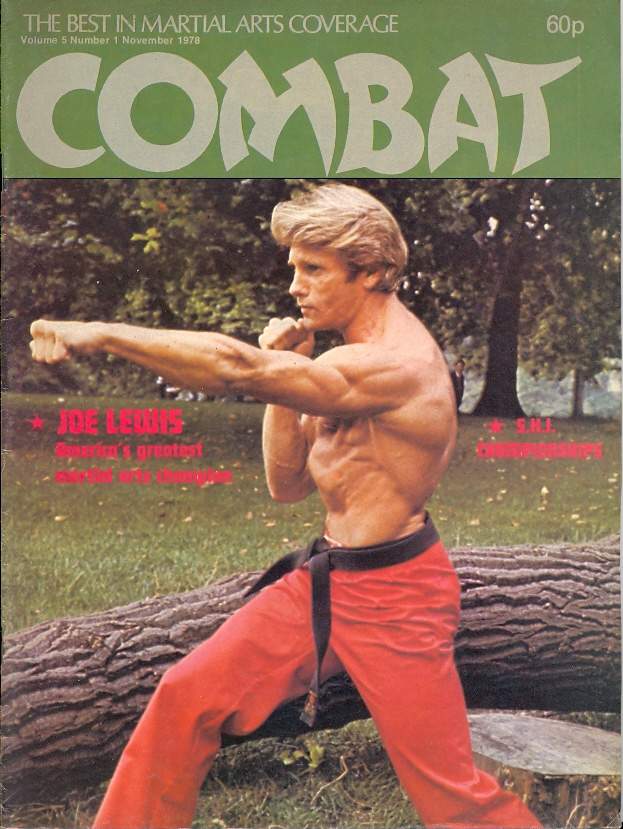
Joe Lewis may very well be the best and most influential martial arts fighter of the 20th century. With a physique chiseled out of stone and some of the very best technque in the sport, Joe Lewis was a formidable opponent for anyone. As a fighter, even the best (Chuck Norris and Bill Wallace included) were afraid to face him in the ring. As an instructor, even the best ravel miles seeking his instruction. As a man, who I have had the privilege to speak to, he is an artist, a philosopher, a comedian, a scientist, and most of all, an inspiration. Today, he is Martial Artist of the Month.
Biography:
Growing up in South Carolina during the 1940s and 1950s, Joe Lewis came from a rough neighborhood. Lewis was brought up on a farm, leaning early on about hard work, which was something he would outshine other martial artists on for over half a century. Taking up an interest in bodybuilding and power lifting, Lewis began training in secret to avoid his father's dissaproval, lifting weights at night after completeing chores on the farm. Joining the Marines in 1962, Lewis was deployed to Vietnam where he worked in communictions. After being transfered from Vietnam to Okinawa, against Lewis' whishes and request for another tour of duty in Vietnam (yes, you read that correctly), he began studying karate under renowned instructors Ezio Shimabuku, John Korab (who Lewis credits as the man who taught him how to spar), and Kinjo Kinsoku. Lewis earned his first black belt in seven months. Most instructors consider two years to be excellent progress. After returning to America, Lewis entered his first tournament, Jhoon Rhee's U.S Nationals, with only twenty-two months of karate training and won the grand championship in both kata and sparring divisions. He scored every point with his trademark sidekick (an irony considering Lewis' self proffessed love of inside fighting). After racking up victories over Chuck Norris, Skipper Mullins, Alan Steen and a plethora of other martial arts greats, and setting numerous records, including another three consecutive wins at the U.S Nationals, Lewis was recognized as the most intimidating fighter in sport Karate. During this time, Joe Lewis began studying Jeet Kune Do with Bruce Lee, who would remain his cheif instructor for the next two-and-a-half years. It was in 1970 that Lewis made the breakthrough in modern martial arts history by introducing Full Contact Karate or "Kickboxing", as it would become known. It was America's first sanctioned full contact martial arts event. Winning the original Heavyweight Championship and defending his tittle ten times, Lewis retired until the PKA World Championship in Full Contact Karate in 1973, in which he again won the world title in the Heavyweight devision. It should also be noted that Lewis was the key figure responsible for convincing Bill Wallace to join the sport that year (Wallace won and held the tittle until his retirement in 1980). Retiring in the late 1970s, Lewis embarked on a short film career, starring in the thriller "Jaguar Lives!" as well as co-starring with fellow martial arts legends Benny Urquidez, Richard Norton, and Bong Soo Han in "Force Five". Lewis was not done, however. He launched the martial arts seminar market, becoming, along with Bill Wallace, perhaps the most successful seminar instructor. Today, Lewis continues to teach his cutting edge seminars and has his own martial arts curriculum, the JLFS.
Why So Great?
How does one answer this question in light of the fact that Joe Lewis has done it all, done it first, and done it best? I guess you pick out the reasons that stand out among the rest.
(1) He pioneered full contact. You hve to understnd that before 1970, martial arts competitions were point matches and in most tournaments, contact was not allowed. Although Lewis fought in and won his fair share of these competitions, he was never satisfied that martial artists who proclaimed to be fighters were satisfied by these games of tag. Even tournaments such as Alan Steens' competitions in Texas, which allowed heavy contact, still used the point fighting system and separated fighters after each point was scored. The idea of wearing boxing gloves, adding contact, and fighting continuously through the round was simple, Lewis was the only one who promoted the idea. Perhaps no one wanted to find themselves under these rules looking across the ring at Joe Lewis. Eventually Joe Lewis made a deal with George Bruckner to compete in an East vs. West point tournament if Bruckner would help Lewis establish his new sport. Lewis cleaned house at the point tournament and Bruckner held up his end of the bargain, promoting the first full contact martial arts event in America: Joe Lewis vs. Greg Baines. Lewis won by knockout and the fight footge is still available today (Lewis has even recorded an audio commentary that is available with the footage on his video "What Bruce Lee Taught Me"). I don't think it can be argued otherwise that the UFC and other similar events would not exist the way they do today had it not been for Joe Lewis.
(2) He worked harder than anyone. Take a look at Joe Lewis without his shirt on and it's hard to find proffessional athletes in any sport with his level of fitness and dedication. Lewis was a country raised farm boy (that means hard work to you city boys), Marine, power lifter, long distance runner, wrestler, World Karate Champion, boxer (Lewis studied with Joe Orbillo and is the only martial artist to be featured on the cover of Ring Magazne), and world Kickboxing Champion. He was always in phenominal shape and could out perform and out last even the best of competition. Comparing his ripped physique to your own would be demoralizing in the ring. Joe Lewis wore those open top, short sleeved gis for reason, you know. Even Bruce Lee was enamored at Lewis' defined physique and would frequently ask him detailed questions on how he acquired it.
(3) He was willing to engage with complete and total conviction. This is a rare and important quality in combat sports. When most people punch, kick, or shoot for the takedown, they execute with a lack of conviction, meaning they don't put their very heart, soul, and intended purpose behind the movement. Remember that scene in Enter The Dragon where Bruce Lee says "I sais emotional content"? That's what he was talking about and Joe Lewis had it in spades. It is of course partly due to Bruce Lee's instruction that Lewis developed this defining quality. Whether you are watching Lewis in his old fight footage or as he teaches a seminar today, he moves with a level of mental assuredness and confidence that is hard to find.
(4) Lewis has perfectly broken down the fight game into understandable principles. Lewis understands that it's not the techniques that win fights but what you put behind them and what you put "between" them. What this means is that the techniques themselves are not as important as the principles applied to make them work. Lewis has defined what he refers to as "Universal Combat Principles". These are combat principles that transend style and form. It doesn't matter if you are a karate man or a wrestler, you need to control your opponent's set point, control the distance, dictate the pace, control ring generalship, etc. How many of us try to counter when we should fire first or forget to step in when we execute? What do you do if your favorite technique fails to work for you? Could you set it up another way? These are the fighting principles that Joe Lewis has so successfully defined and made understandable to practitioners of any style. What he has done in the way of martial arts instructional knowlege is unmatched.
(5) Joe Lewis puts the fans first. Attend a martial arts expo, hall of honors, or similar ceremony and you are likely to find Joe Lewis coming by your table to visit. He understands that without people to embrace the martial arts and support it, you work for nothing. After all, who do martial artists fight for if not for the fans? Joe Lewis is as down to earth as a man can be and although he was the greatest martial arts fighter of his time (or in my opinion and in the opinion of many others, all time) and is now one of the leading instructors in his field, he has no ego. Joe Lewis even allowed me to interview him for this blog and that, brother, tells you everything you need to know about a man who has conquered the world, and in the process, a plethora of unlucky opponents, when it comes to putting the fans first!
Overall:
In the end, not enough can be said of the many accomplishments of Joe Lewis. He is "The Greatest Karate Fighter of all Time" as chosen by his peers, the Father of Ameican Kickboxing, and many more unrivaled tittles. But, to keep our definitions simple, as I believe Joe Lewis would, I'll stick to my favorite name for him: "CHAMPION".
Wednesday, March 23, 2011
Martial Artist of the Month: Benny "The Jet" Urquidez

If asked who I would pick, of all the martial artists who ever lived, to have on my side in a fight for my life, I would choose Benny "The Jet" Urquidez. Not just because of his unrivaled skill, but because of his warrior's heart, tenacity, determination, mental toughness, competativeness, and courage. He was the first and only individual to come into my head when deciding who to first feature as "Martial Artist of the Month".
Biography:
It's hard to imagine how Benny Urquidez could not have become a great fighter. His father was a boxer and his mother was a wrestler. At the age of five, he was already competing in Pee Wee Boxing tournaments. At the age of fourteen, Urquidez shocked the martial arts community upon passing his two day black belt exam under the instruction of his older brother and professional karate competitior Arnold Urquidez and renowned Kempo pioneer, Ed Parker. Capturing the public's eye with his impressive wins in Belgium and England as a member of Ed Parker's International Karate Team in 1974, it was clear that he was the fighting star of the Elvis Presely produced martial arts documentary, The New Gladiators, which covered these events. After participating in the greatest point karate match in the sport's history against John Natividad, Urquidez was offered a new venture to develope his fighting skill: full contact karate or "kickboxing". Fighting anyone he could, Urquidez, now nicknamed "The Jet" after his fantastic spinning back kick, won the championship under every sanctioning body for which he fought. Retiring in the early nineties with a record of 58-0-1 (very contraversial last digit), Urquidez had already co-starred in several films with martial arts cinema legends such as Jackie Chan and Samo Hung. Urquidez was also added to the Black Belt Hall of Fame as "Fighter of the Year" in 1978. He now teaches his own martial arts curriculum Ukidokan, which means "A Way of Life".
Why So Great?
Benny "Ther Jet" isn't just great, he's phenominal. Here are the reasons "The Jet" makes my number one choice for Martial Artist of the Month.
(1) He would fight anyone. Not almost anyone, but anyone. Urquidez showed what it takes to be a true world champion. And that is to prove your worth against anyone in the world that you claim to be champion of. Urquidez was the first American fighter to seek bouts over seas, fighting with the Japanese champions and crossing over into the Muay Thai arena also. No other fighter of his caliber would take on a bout without knowing the oponent but Urquidez would often be promised one opponent only to have a switch pulled, forcing him to fight bigger and stronger oponents than expected. No problem for "The Jet" though, he beat them anyway. In some instances, Urquidez beat multiple fighters the same night, one right after the next.
(2) He would fight under any rules. Not almost any rules, but any rules. Urquidez would accept challenges from any fighter who issued one and agree to fight under their set of rules and even in their hometown. Having trained in a variety of martial arts discelplines certainly helped, but it was unprecedented and still unmatched. The Gracies claim to accept all challenges, but not under any rules. Urquidez was unique in that way. There are even unproven rumors that Urquidez accepted a challenge from the Gracie family but that they pulled out upon learning he held a black belt under grappling master, Gene LeBell.
(3) Size was no obstacle. I'm a small guy and so is Urquidez. I can relate to the pressure of fighting a bigger man and never was there a little guy who beat on the bigger oponents like Benny Urquidez did. In 1974, Urquidez, who is five feet six, took on six feet one Dana Goodson in Hawaii. Urquidez fought his heart out and dominated the larger oponent, earning the nickname "The Giant Killer" in Hawaii. It wasn't just size though, Urquidez would fight faster men, stonger men, more experienced men, and would beat them all.
(4) He embrassed the old and the new. Many fighters will stubornly hold fast to either classical or newer methods, never willing to try the other. Not Urquidez, he used both. Urquidez holds multiple black belts in classical styles but always worked to adapt the techniques when necessary. Watching his full contact bouts, you can see how he draws from karate, judo, kung fu and more, integrating the older arts with the new sport. Myself having come froma classical Tae Kwon Do background and now practicing mixed martial arts, I can relate to Urquidez and admire him for this reason.
Overall:
In the end, Benny "The Jet" Urquidez exhibits all the traits of greatness. His never-quit-attitude, willingness to engage any oponent, practice of traddition, acceptance and mastery of new methods, adaptability, and deep understanding of philosophy and human nature solidify him as a true martial artist and warrior, no matter which perspective you may have. His influence in the fight game will be forever felt and generations upon generations of martial artists will look up to him for inspiration. Here he may be "Martial Artist of the Month" but in our hearts, he may be Martial Artist of A Lifetime.
Here is a great clip about Benny "The Jet" Urquidez. http://www.youtube.com/watch?v=50HDAMmAGLc
Thursday, March 10, 2011
Is Honor Exclusive To Combat?

"It's about honor and discepline". That's what you'll hear when you ask Grand Master "Kim" what the purpose of martial arts is. "It's about respect and humility" he'll say. These are the facets of martial arts that have come to be accepted as part of their long tradition. Many styles emphasise these virtues as if you can't fight without them. But are they really so important to a martial artist? Are these virtues exclusive to combat?
This is quite an interesting question. The modern martial artist who is trained in a classical school -usually styles such as Tae Kwon Do (my first style), Karate, Aikido, and others- knows certain values are to be demonstrated at all times on the mat and in their daily life. A student is taught by his instructors to honor and respect those of authority. The student is to show patience at all times. Humility is the mark of a black belt, some will say. Now, I have no quarel with anyone who wishes to live by these virtues and proclaim their importance. They are the foundations on which we are to build our character. But when someone claims that you cannot be an effective martial artist without such character traits in place, they have made several mistakes.
First, there is no solid definition for "martial artist". Each style, school, teacher, and practitioner has their own take on what this means. Is it about how well you can fight in the street to save your life? Is it about competition? What kind of competition, full contact, submission, point fighting? Is it about kata practice or meditation? Who defines what the word "martial artist" means? One cannot say a martial artist must have specific virtues if one cannot first define what makes a martial artist.
Martial arts were originally invented by soldiers near the Indian/Chinese border and these records are left for us by way of inscriptions on turtle shells (early paper, I guess). After dynasties rose and fell, some historians believe that these warriors fled to China, taking their martial arts with them, and hid in Buddhist temples. Before this time, martial arts were practiced for the sole purpose of increasing a foot soldier's ability to kill his enemy in battle. But true to Chinese philosophy, the monks who harbored these men found meaning in all things and wove their philosophy into the practice of these arts. Soon, the arts had been so infused with Tao philosophies that it became standard practice for Shoalin monks to practice the art. Their new styles included movements based on animals and became what was known as "Wushu" and "Gong Fu". The more recognizable translation is "Kung Fu". From there, martial arts spread across the world to Japan where it became Karate, Judo, and Jiu-Jitsu. Jiu-jitsu spread to Brazil where it became Gracie Jiu-Jitsu or Brazilian Jiu-Jitsu. Kung Fu's influence spread to Korea where it became Tae Kwon Do. Martial arts spread to Europe where it became boxing. Karate spread to America and combined with boxing to become kickboxing. These are the means by which martial arts have come to dominate the globe. And each continent, country, civilization, people group, and individual who developes a style of combat does so for a specific purpose, to fill a specific need. Who are we as individuals to define what their martial art must include in the way of virtue?
Let's answer one of our questions: Does a martial artist need virtues such as honor or respect to be a talented fighter? The answer, despite what you may have been taught in class, is "no". Mike Tyson is not an outstanding model of virtue but one cannot argue his effectiveness in the ring. Likewise, UFC middleweight contender Chael Sonnen would hardly be used as an example of humility but it doesn't stop him from dominating his opponents from bell to bell. Muhammad Ali proudly boasted to be "The Greatest" and was perhaps the greatest fighter the world has ever seen. Although it is nice to see a fighter display the virtues that form the basis of good character, it simply is not necessary for one to develope fighting proficiency. Must one develope humilty to be a good NFL quarter back or Olympic runner? Of course not. Why would anyone assume it's necessary for fighting and what scientific data could support such a claim?
Let's answer another question: Does a martial artist have to demonstrate patience and discipline? The answer is "yes". It's not a rule, just a fact. Developing proficiency in martial arts takes thousands of hours of hard practice and requires many sacrifices. An undisciplined individual must develope this quality as they progress or come into the arts demonstrating it. The better you want to be, the more work and sacrifices will be required of you and that means more disclipline. Patience is also crucial because you don't become world champion over night. Although the harder you work the faster you can progress, it still takes lots of time to develope any skill, especially unarmed combat.
In the end, virtues such as honor and respect are important for all people, regardless of their endeavor. However, it isn't entirely accurite to say that you aren't a martial artist without them. The're are far too many methods and reasons for practicing martial arts to assign identical mandatory rules of conduct and morality to them all. A realistic altercations expert may use these virtues to avoid a fight but doesn't need them for the fight itself. A competitior is only required to follow the code of conduct stipulated by the event's governing body. A traditional practitioner's level of moral conduct will change from one school to another. Let's work on achieving good character as human beings, regardless of our endeavor, before we assign them to someone's fighting style.
This is quite an interesting question. The modern martial artist who is trained in a classical school -usually styles such as Tae Kwon Do (my first style), Karate, Aikido, and others- knows certain values are to be demonstrated at all times on the mat and in their daily life. A student is taught by his instructors to honor and respect those of authority. The student is to show patience at all times. Humility is the mark of a black belt, some will say. Now, I have no quarel with anyone who wishes to live by these virtues and proclaim their importance. They are the foundations on which we are to build our character. But when someone claims that you cannot be an effective martial artist without such character traits in place, they have made several mistakes.
First, there is no solid definition for "martial artist". Each style, school, teacher, and practitioner has their own take on what this means. Is it about how well you can fight in the street to save your life? Is it about competition? What kind of competition, full contact, submission, point fighting? Is it about kata practice or meditation? Who defines what the word "martial artist" means? One cannot say a martial artist must have specific virtues if one cannot first define what makes a martial artist.
Martial arts were originally invented by soldiers near the Indian/Chinese border and these records are left for us by way of inscriptions on turtle shells (early paper, I guess). After dynasties rose and fell, some historians believe that these warriors fled to China, taking their martial arts with them, and hid in Buddhist temples. Before this time, martial arts were practiced for the sole purpose of increasing a foot soldier's ability to kill his enemy in battle. But true to Chinese philosophy, the monks who harbored these men found meaning in all things and wove their philosophy into the practice of these arts. Soon, the arts had been so infused with Tao philosophies that it became standard practice for Shoalin monks to practice the art. Their new styles included movements based on animals and became what was known as "Wushu" and "Gong Fu". The more recognizable translation is "Kung Fu". From there, martial arts spread across the world to Japan where it became Karate, Judo, and Jiu-Jitsu. Jiu-jitsu spread to Brazil where it became Gracie Jiu-Jitsu or Brazilian Jiu-Jitsu. Kung Fu's influence spread to Korea where it became Tae Kwon Do. Martial arts spread to Europe where it became boxing. Karate spread to America and combined with boxing to become kickboxing. These are the means by which martial arts have come to dominate the globe. And each continent, country, civilization, people group, and individual who developes a style of combat does so for a specific purpose, to fill a specific need. Who are we as individuals to define what their martial art must include in the way of virtue?
Let's answer one of our questions: Does a martial artist need virtues such as honor or respect to be a talented fighter? The answer, despite what you may have been taught in class, is "no". Mike Tyson is not an outstanding model of virtue but one cannot argue his effectiveness in the ring. Likewise, UFC middleweight contender Chael Sonnen would hardly be used as an example of humility but it doesn't stop him from dominating his opponents from bell to bell. Muhammad Ali proudly boasted to be "The Greatest" and was perhaps the greatest fighter the world has ever seen. Although it is nice to see a fighter display the virtues that form the basis of good character, it simply is not necessary for one to develope fighting proficiency. Must one develope humilty to be a good NFL quarter back or Olympic runner? Of course not. Why would anyone assume it's necessary for fighting and what scientific data could support such a claim?
Let's answer another question: Does a martial artist have to demonstrate patience and discipline? The answer is "yes". It's not a rule, just a fact. Developing proficiency in martial arts takes thousands of hours of hard practice and requires many sacrifices. An undisciplined individual must develope this quality as they progress or come into the arts demonstrating it. The better you want to be, the more work and sacrifices will be required of you and that means more disclipline. Patience is also crucial because you don't become world champion over night. Although the harder you work the faster you can progress, it still takes lots of time to develope any skill, especially unarmed combat.
In the end, virtues such as honor and respect are important for all people, regardless of their endeavor. However, it isn't entirely accurite to say that you aren't a martial artist without them. The're are far too many methods and reasons for practicing martial arts to assign identical mandatory rules of conduct and morality to them all. A realistic altercations expert may use these virtues to avoid a fight but doesn't need them for the fight itself. A competitior is only required to follow the code of conduct stipulated by the event's governing body. A traditional practitioner's level of moral conduct will change from one school to another. Let's work on achieving good character as human beings, regardless of our endeavor, before we assign them to someone's fighting style.
Wednesday, January 12, 2011
What Are the Best Foundation Arts?
In the ever growing world of martial arts, more and more people are learning more and more styles and mixing them together. Although there is no single most effective style of martial art, it ultimately comes down to the individual, certain martial arts make better foundation arts. A "foundation art" is a style of fighting that a practitioner begins with and builds a repertoire on top of. It also serves as comfort zone or means of recourse that the practitioner can go back to if the fight is getting really tough. There are specific qualities that must be exhibited by a martial art to fit into the small selection of good foundational arts. First, the less amount of material that must be discarded or changed, the better. Idealistically, there shouldn't be any. Tae Kwon Do for example, although an exceptional martial art with beautiful and effective kicking and outside distance techniques, makes a poor foundational art because a large amount of material that must be discarded to make it one-hundred percent effective. Outdated blocking techniques and punches from the hip aren't going to work in a full contact bout or a realistic altercation. Those ineffective techniques must be discarded and it is this type of problem that good foundation arts must avoid. Second, a good foundation art should also allow the practitioner ease of transition between techniques of various arts. What follows are several arts that best follow these criteria. Keep in mind, there is no single best style and all martial arts have their specific uses. This is a list of martial arts specifically chosen as the best choices for foundational arts from which to build upon to achieve success in full contact, mixed martial art bouts or realistic altercations.

(1) Wrestling
There may be no better foundational art than free-style or Greco Roman wrestling. Wrestling provides excellent balance because of the low center of gravity in it's stances and it is very easily combined with other grappling and even striking arts. Wrestlers are some of the most well conditioned athletes in the world and the mental discipline it provides is second to none. There are very few styles that produce tougher fighters than wrestlers. You can beat a wrestler senseless and they won't quit. They make you quit. Although there are many grappling arts around the world, the take downs in wrestling are by far the best. Another advantage is emotional content in the execution of technique. many fighting styles produce fighters with good technique who lack conviction. Wrestlers put conviction behind every movement. When they take you down, they run right through you and take you to the mat hard. Their sense of competitiveness is visual in every action. In short, wrestlers are dangerous and are usually the fastest to pick up other martial arts. Joe Lewis and Bill Wallace, though famous for their kickboxing careers, both share wrestling as their foundational art. Other phenomenal wrestlers or wrestling based fighters in the martial arts game include George St. Pierre, Matt Hughes, and Chael Sonnen.

(2) Boxing
When it comes to foundational arts, few compare to "the sweet science". Perhaps the most technically advanced and scientific fighting art, boxing is the premiere example of a style in which everything works. Boxing provides the best footwork in sports and because it features only four techniques, the jab, cross, hook, and uppercut, it relies heavily on the use of good strategy. Boxing utilizes feints and faking on a higher level than most fighting arts. Boxer's are also very fast in comparison with many other fighters. And then there's defense. The head rolls, body rolls, shoulder rolls, slips, bobs and weaves of boxing provide better defensive skills than any other style. It is incredibly hard to hit a well trained boxer. And the training grind in the sport of boxing is more intense than most athletic endeavors. All of this, combined with boxing's brilliant use of the jab, which may be the single best technique ever created, make the practice of pugilism one of the best foundation arts there is. It has served as my foundation art since I began the study of combat at age fourteen. History's best boxers include Muhammad Ali, Sugar Ray Robinson, and Willie Pep. One of today's best boxers is current world champion (in eight devisions) Manny Paquiao, and one of UFC's most advanced boxers is current lightweight world champion, Frankie "The Answer" Edgar.

(3) Muay Thai
Undoubtedly, Muay Thai produces some of the toughest fighters in the world. The mentality of Thai fighters finds it's roots in the art's home country of Thailand, where the fighters don't visit the gym every day, but live there. Alongside wresting, Muay Thai produces the toughest fighters I've ever seen. Even if you kill a Thai fighter, his zombie will knock you out. Muay Thai is similar to boxing with several major differences: elbows, knees, kicks, and a vice like clinch. And Muay Thai people don't kick like point fighters, they turn the hip over before releasing the kick for maximum power. And when it hits you, it hits with the shin bone, often targeted to the cutaneous femoral and sciatic nerves in your leg. Elbows are designed to cut across the eyebrows. The knee strikes will break your ribs, cheek bones and nose. Thai fighters are disciplined to fight through these types of injuries, regardless of pain. Muay Thai provides effective technique that is safe for the user, dangerous to the target, and easy to integrate into other disciplines. One of the best Muay Thai fighters in mainstream martial arts today is current UFC middleweight world champion, Anderson "The Spider" Silva.

(4) Brazilian jiu-jitsu
Out of no where in 1993, Brazilian jiu-jtsu practitioners collectively known by their family name, Gracie, shocked the world with a new and dangerous martial art. Wrestling may be the best art for putting people on the ground, but Brazilian jiu-jitsu is by far the best for making sure they don't get back up, at least not without your permission. Brazilian jiu-jitsu wastes no time with ineffective techniques or disciplines, it's all business. Using leverage to lock joints or manipulate your way into a submission, this art is subtle, the smallest advantage leading to victory and the smallest mistake leading to defeat. Brazilian jiu-jitsu has changed much since it's world debut in 1993, but a few things have remained the same: it's dangerous, scientific, versatile, and a great foundation art. Just like boxing, you can use feints and fakes. Instead of faking a punch one way and redirecting it, you could fake a punch and execute a take down, or bait your opponent with false attempts to gain half guard only to pivot into full guard on the other side. It's easy to see how you can blend this with other fighting styles. Some of the best Brazilian jiu-jitsu practitioners in the world include the Gracies, the Muchado brothers, and B. J. Penn.
Keep in mind, any martial art can be put to use as a foundation art. But it's easier to work with arts that allow you to learn and progress instead of spending time identifying and cutting out the useless stuff. You should pick an art that follows this criteria and fits your own personal fighting mentality. Then blend it with other useful arts to better round out your fight game. For instance, the four arts above can be meshed seamlessly: fake a jab, cut kick the leg and execute a take down, pass the guard and apply a submission. Get the idea?
Sunday, January 9, 2011
Arachnophobia In The Octagon

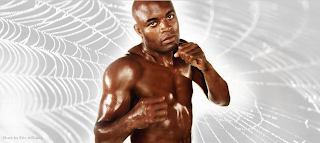
Most spiders are completely harmless. However, the anyone in the UFC's middleweight devision (and occasionally light heavyweight devision) better fear the octagon's resident spider. He's six feet-two, one hundred and eighty-five pounds, and considered by most to be the top pound for pound fighter in modern mixed martial arts. He is none other than Anderson "The Spider" Silva.

With an impressive professional record of 27-4-0, Silva has proven to be an incredibly well rounded fighter with a more diverse martial arts background than many of his competitors. Having studied Tae Kwon Do, Muy Thai, Brazilian Jiu-Jitsu, and boxing, there aren't many areas of the fight game that will make "The Spider" uncomfortable. In fact, his competitors are still searching for them. After setting a record for both wins without losses and tittle defenses, nobody is sure of what it is that makes Anderson Silva so good. Many people have attempted explaining it but the answers are surface observations: "he's fast" or "he's just so well rounded". What is it that makes this man so much more dangerous than the other top fighters in the octagon? It's hard not to notice, as Forest Griffin observed before his bout with Silva, "he makes really good fighters just look bad". Forest would later find out how right he was.

Although there is much to discuss concerning the competence and skill of Anderson Silva, his largest strategic advantage can be described in single word form: "distancing". To land any kind of offensive, one must be properly distanced, able to cover that distance, and then clear it to avoid being hit themselves. Silva doesn't have the best penetration and clearing in the octagon, that prize goes to Frankie "The Answer" Edgar, but he is the best when it comes to taking advantage of his opponents lack of this same ability. Silva, nine times out of ten, is an elusive "cat and mouse"
 type fighter, someone who prefers to lead his opponent into a trap. He hangs back, just outside of his opponent's critical distance line and causes fighters to lunge at him. This adds too much hang time at the end of his opponent's technique and leaves them vulnerable to Silva's counter strikes. Notice that Silva rarely ever blocks techniques. He doesn't have to, he is always a few inches out of range when his opponents execute. After gaging the distance and timing of his opponent, causing them to include additional hang time and compromise balance by lunging, Silva will switch from leaning out of techniques to slipping inside them and executing his own. This is a tactic utilized by many outside zone fighters of various fighting styles. Because of this, no one has been able to effectively hit Silva on his terms.
Anderson Silva gets into trouble in two places, usually against wrestlers: against the cage where his distancing abilities are compromised and when he tries to stop a wrestler's take down in their tracks instead of hitting the head or shoulder to the side and using circular footwork. Both of these mistakes are mistakes in distancing and that's where Silva is most vulnerable. Chael Sonnen, Dan Henderson, and Travis Lutter all forced Silva to the cage or coaxed Silva to stand toe to toe with them. It's not that Silva has a bad ground game. Every fighter who has managed taking Anderson to the ground regretted it and tapped out, including all three of the previously mentioned fighters. It's simply that his most impressive asset and consequently what makes Silva look so good, which is his distancing, is compromised against the cage and on the ground.
Of course their are many more assets used by "The Spider" to eliminate his adversaries, including speed, basic angular attack, intimidation, and incredible mental and physical toughness. But I believe I can say with certainty that distancing and timing are the very misunderstood answers people have been searching for. Silva wishes to retire soon and may very well be the first fighter/champion in the UFC to retire undefeated. Until he does, he poses a very real threat to anyone after the twelve pounds of gold around his waist. He rules the cage which, incidentally, is shaped just like a spider's web.
Monday, December 20, 2010
What About Board Breaking?

Recently, a friend of mine who is a black belt, suggested I get some breaking boards to work with the next time I get some friends together to work out. I was expecting to him to say that, before the day was over. Perhaps the first image that one has upon hearing the words "martial arts" or "Karate" is that of a practitioner breaking through a stack of boards or bricks with a powerful side kick or reverse punch. It's become such a basic facet of martial arts lore and tradition that few people stop to consider what it's for or whether it's even useful. And that's the point of this blog post.
Board breaking is used to demonstrate a practitioner's perfection of technique: form, power, balance, etc. One person holds the board, or several in a stack, if the practitioner is really good, and the other executes a specific strike in attempt to break it.The boards are usually made of pine and vary in thickness. This practice, along with Kata, has become one of the most important facets of most classical martial arts curriculum. Instructors and students alike will swear by it and it is required in all belt testing.
There are certain issues I must take up against board breaking. First, it's a gimmick. Breaking a board only means one thing: you can break a board. Boards do not move, hit back, or even feel like a real opponent. If someone stacks up ten boards and side kicks through them all in one shot, that same person might miss an opponent who can only break two boards but spent more time on footwork. It's not a coincidence that few champion board breakers become champion full contact fighters. If board and brick breaking were proof of real life technique mastery, then why doesn't the world champion brick and board breaker enter into the UFC and break Anderson Silva or Frankie Edgar in half with the same move they used to split ten cinder blocks? All they would have to do is hit them once, right?
Consider this: If a fighter becomes undisputed world champion by using fast techniques with a little power, deceptive speed and good timing and can break three or four boards with the same moves, is he less advanced than other practitioners who can break ten boards with their classical methods? Is their technique "better", or is there more to technique development than how many boards you can break? Why are we judging techniques that were designed to enforce our will over our opponent by how well they damage the fibers found in one inch slats of American pine? How does "enforcement of will" relate to "disruption of cellulose"?
Board breaking is used to demonstrate a practitioner's perfection of technique: form, power, balance, etc. One person holds the board, or several in a stack, if the practitioner is really good, and the other executes a specific strike in attempt to break it.The boards are usually made of pine and vary in thickness. This practice, along with Kata, has become one of the most important facets of most classical martial arts curriculum. Instructors and students alike will swear by it and it is required in all belt testing.
There are certain issues I must take up against board breaking. First, it's a gimmick. Breaking a board only means one thing: you can break a board. Boards do not move, hit back, or even feel like a real opponent. If someone stacks up ten boards and side kicks through them all in one shot, that same person might miss an opponent who can only break two boards but spent more time on footwork. It's not a coincidence that few champion board breakers become champion full contact fighters. If board and brick breaking were proof of real life technique mastery, then why doesn't the world champion brick and board breaker enter into the UFC and break Anderson Silva or Frankie Edgar in half with the same move they used to split ten cinder blocks? All they would have to do is hit them once, right?
Consider this: If a fighter becomes undisputed world champion by using fast techniques with a little power, deceptive speed and good timing and can break three or four boards with the same moves, is he less advanced than other practitioners who can break ten boards with their classical methods? Is their technique "better", or is there more to technique development than how many boards you can break? Why are we judging techniques that were designed to enforce our will over our opponent by how well they damage the fibers found in one inch slats of American pine? How does "enforcement of will" relate to "disruption of cellulose"?
Thursday, December 9, 2010
Master Fighters and Master Teachers: Are They The Same?
Is your martial arts instructor a master fighter? Must an instructor be an expert at performing the techniques he or she teaches their students? This question has been the subject of much discussion and rightfully so. If your instructor must be an expert fighter to be an expert teacher of fighting, this would considerably narrow the field of good instructors. This view of "master teacher is a master fighter" would be true if teaching the art of combat was one dimensional. But it isn't.
Different instructors work with students in different areas and indifferent ways. Some instructors teach discipline, some focus on sparring science, some are best at giving us the confidence we need to use what we have learned from other instructors. It's helpful if your instructor can perform the techniques with an expert level of efficiency and this is very important for younger students who need visual examples. But more advance concepts can be taught on master's level without being an expert fighter, or even an expert of performing the technique. This can be equated with most other sports. Bill Belichick of The New England Patriots is currently the highest rated coach in the NFL and has never played football on a professional level. Similarly, the greatest gymnastics coach in history, Bela Karolyi, only participated in gymnastics on an amateur level. However, both of these men teach the world's top competitors in their respective sports. Belichick cannot blitz or block for a professional running back in an NFL game but that's what he teaches his players to do on an expert level. Karolyi cannot score a perfect ten in the Olympic finals but two of his students have under his instruction.
In the fight game, the best example is boxing. Many of history's greatest boxing coaches were never master fighters. legendary boxing instructor Eddie Futch, who trained such greats as Joe Frazier, Ken Norton, and George Foreman, was never a professional fighter but only a sparring partner to the legendary Joe Louis. Angelo Dundee, perhaps the greatest boxing trainer of all time, never put the gloves on at all. Angelo learned how to teach boxing by keen observation while working for years as a bucket man. By martial artist's standards, he would not be qualified to teach anyone how to fight. But he has taught no less than fifteen world champions, including Sugar Ray Robinson, Willie Pep, and Muhammad Ali, who are perhaps the three greatest boxers to have ever lived. But don't think about training with old Angelo if you want to learn how to fight because he doesn't have a "Grand Master" tittle or a seventh degree black belt around his waist...
There are many great fighters who aren't great teachers and many great teachers who aren't great fighters. If Dan Inosanto fought Mike Tyson in their prime, I would bet the family farm on Mike Tyson because he's a better fighter. But if I wanted to learn how to fight, I would go straight to Dan Inosanto because he's a better teacher. Kicking really fast or hitting really hard doesn't mean you are able to teach other people to do the same. Teaching and fighting are two separate skills that take much talent and hard work to master. Let's not confuse them.
Different instructors work with students in different areas and indifferent ways. Some instructors teach discipline, some focus on sparring science, some are best at giving us the confidence we need to use what we have learned from other instructors. It's helpful if your instructor can perform the techniques with an expert level of efficiency and this is very important for younger students who need visual examples. But more advance concepts can be taught on master's level without being an expert fighter, or even an expert of performing the technique. This can be equated with most other sports. Bill Belichick of The New England Patriots is currently the highest rated coach in the NFL and has never played football on a professional level. Similarly, the greatest gymnastics coach in history, Bela Karolyi, only participated in gymnastics on an amateur level. However, both of these men teach the world's top competitors in their respective sports. Belichick cannot blitz or block for a professional running back in an NFL game but that's what he teaches his players to do on an expert level. Karolyi cannot score a perfect ten in the Olympic finals but two of his students have under his instruction.
In the fight game, the best example is boxing. Many of history's greatest boxing coaches were never master fighters. legendary boxing instructor Eddie Futch, who trained such greats as Joe Frazier, Ken Norton, and George Foreman, was never a professional fighter but only a sparring partner to the legendary Joe Louis. Angelo Dundee, perhaps the greatest boxing trainer of all time, never put the gloves on at all. Angelo learned how to teach boxing by keen observation while working for years as a bucket man. By martial artist's standards, he would not be qualified to teach anyone how to fight. But he has taught no less than fifteen world champions, including Sugar Ray Robinson, Willie Pep, and Muhammad Ali, who are perhaps the three greatest boxers to have ever lived. But don't think about training with old Angelo if you want to learn how to fight because he doesn't have a "Grand Master" tittle or a seventh degree black belt around his waist...
There are many great fighters who aren't great teachers and many great teachers who aren't great fighters. If Dan Inosanto fought Mike Tyson in their prime, I would bet the family farm on Mike Tyson because he's a better fighter. But if I wanted to learn how to fight, I would go straight to Dan Inosanto because he's a better teacher. Kicking really fast or hitting really hard doesn't mean you are able to teach other people to do the same. Teaching and fighting are two separate skills that take much talent and hard work to master. Let's not confuse them.
Monday, November 22, 2010
Three Basic Teaching Tips
In my estimation, teaching is probably the most important job there is. This is a bold claim, as all jobs form the social structure that makes life possible, and like the food chain, each effects the others. However, without the proper knowledge, nothing can be accomplished as you can only act with constructive purpose by following your mind's recognition of how to complete a task. Therefor, all tasks, mental or physical (other than instinctual needs and reactions) must be learned, and some of us help others learn as our livelihood: it's called teaching. Although the saying goes that "those who can't do, teach", it is more probable that "those who teach, can do anything". You see, spouting off information is merely talking. Helping someone understand that information, how it applies to them, appreciate it as a fascinating subject, become inspired to master it and therefor, master their own will, and show them how to accomplish this...this is called teaching. I have met very few people who I would say are great teachers. Having been a teacher of all grade levels, even college aged students, since the age of fifteen, there are quite a few principles I've picked up on concerning this intricate art. Here are three of the most basic, and therefor, most important principles I've learned over the years.
(1) Teaching Is the Art of Simplification. This was my first lesson on teaching, courtesy of my friend and only martial arts instructor, Joel Puryear. Most teachers make little or no effort to break down the material they are teaching, to make it more accessible to the average person. Some teachers even strive to complicate material in a hidden effort to feed their ego as one of the few people able to interpret or understand the given information. This is a byproduct of one's insecurity and a guarantee that no one will be learning much in that class. A good teacher takes information and simplifies it. You should not want your instructional material to be difficult as this is only a sign that you are unable to explain it to your students. This does not mean your material won't take a sufficient amount of hard work on the students part. Executing a well timed counter side kick, working out an algebraic equation, and mastering impressionistic painting are all skills that will take many hours of dedication. Simplification means that a teacher helps the student to better understand the concept behind the skill. Teachers should find simple formulas for explaining information rather than trying to come up with something on the spot. One of the best methods of simplification is to relate a process to something in everyday life a student can relate to. Make simple analogies. Teachers should also give several examples of each concept they are trying to convey. For instance, if you are teaching indirect angular attacks, show the student several different executions of this strategy. Show them how to gain distance and time with the shoulder fake and then execute the side kick underneath. Then show them how to fake a side kick and come over the top with a backfist. Giving several examples will allow students to find the similarities between each one and then identify the concept. It's always inspiring to watch that moment when it clicks, when the student realizes how simple it actually is. Enjoy these moments, it means you are doing your job right. It is an accomplishment on everyone's part when student proclaims, "Oh, that was easy!"
(2) Be A Principle Centered Instructor. A rule says "don't do this" whereas a principle says "this works and always has". I do not believe in "rules" in the application martial arts (or many other subjects) because their are simply too many variables in every situation. When I'm teaching someone, I do not focus on style, I focus on principles. Principles transcend styles and are applicable to any situation. I equate this to geometry. Euclid, the father of geometry, laid out universal principles of geometry which are always applicable, transcending all types of geometry and all geometric problems. For example, a straight line is always the shortest distance between two points. There are no exceptions. This is also one of the universal principles of martial arts: the shortest distance between a weapon and a target is a straight line. It doesn't matter if you are a Karateka, Judoka, or boxer, a straight line is always the shortest distance between two points. The principle transcends each style and remains universally applicable. Another, and more technically advanced, principle would be controlling your opponent's set point. This is essentially dictating how an opponent is positioned in relation to you and how to keep him from finding his distance, alignment, and defensive posture. Once again, it does not matter what form of fighting you study, one should always apply this in combat because it transcends both style and form. You could apply this concept to the work of a professional nutritionist. Ask a nutritionist how to lose weight and they aren't going to give you a customized diet, they are going to give you principles on weight loss: balance your diet, eat low density foods, etc. This method of instruction is important for the benefit of the students but also to the teacher, for it will not only allow you to become a more skilled instructor but will keep you in business. You will be able to reach a much wider range of students this way. Joe Lewis is a premier example of how to be a principle centered instructor. He understands, better than any teacher I have come across, how one may enhance their skill by application and mastery of principles rather than style. Another important part of being a principle centered instructor is to always inspire your students to execute with total conviction. You must also execute the instruction of your material with complete conviction. A half hearted teacher will have no hearted students. It doesn't matter what you are teaching, that will always be true. It's a universal principle.
(3) Make Learning Fun. This is one of the lost arts in the teaching world. You can't expect to keep students very long and you certainly can't expect them to learn much if they aren't having fun. This does not suggest sacrificing hard work. It suggests you get creative with how you have your students go about doing it. The first step in this process is to ignite a student's inner fire, their burning desire to learn, through the application of your material. This means you must be whole heartedly enthusiastic in your work as a teacher. This is the basis for executing the instruction of your material with conviction. Often times a student will be turned on or off to a subject, method, or technique, simply by how enthusiastic their instructor may or may not be, respectively. Bruce Lee was like this. His whole hearted enthusiasm turned many people on to methods or ideas they may not have considered otherwise. Once your students can see that you not only enjoy your given study but enjoy sharing it with them, there is a much greater appreciation among the students for your material. Another and all too overlooked tool is humor. Wildlife biologist Jeff Corwin is, in my opinion, the premier example of the mastery of this tool. Ask someone why they like Jeff Corwin and I'll bet you fifty dollars that their answer will be "Because he's hilarious". Jeff Corwin, who I have had the pleasure of meeting, understands better than anyone how to keep material that many people may consider boring (how many non-wildlife enthusiasts watched wildlife documentaries before he came along?) and show just how enjoyable it can be. He keeps the viewer constantly involved and in on the joke, laughing with him or laughing at him. Bill Wallace is the Jeff Corwin of martial arts. He is not only a master of what he does, but he uses humor as a primary method. Humor in teaching is like a carrier for a vaccine. The vaccine does the work meant to be accomplished but the carrier gets the body to receive it.
There are dozens of other important teaching principles that every instructor should know, but these three are a great starting point. Always remember that your job as a teacher has enormous consequences, good or bad, based upon how you treat this responsibility. Your goal as a teacher is simple: to help your students reach theirs. Take pride in your work and enjoy it. Do your job with effort and dignity.
(1) Teaching Is the Art of Simplification. This was my first lesson on teaching, courtesy of my friend and only martial arts instructor, Joel Puryear. Most teachers make little or no effort to break down the material they are teaching, to make it more accessible to the average person. Some teachers even strive to complicate material in a hidden effort to feed their ego as one of the few people able to interpret or understand the given information. This is a byproduct of one's insecurity and a guarantee that no one will be learning much in that class. A good teacher takes information and simplifies it. You should not want your instructional material to be difficult as this is only a sign that you are unable to explain it to your students. This does not mean your material won't take a sufficient amount of hard work on the students part. Executing a well timed counter side kick, working out an algebraic equation, and mastering impressionistic painting are all skills that will take many hours of dedication. Simplification means that a teacher helps the student to better understand the concept behind the skill. Teachers should find simple formulas for explaining information rather than trying to come up with something on the spot. One of the best methods of simplification is to relate a process to something in everyday life a student can relate to. Make simple analogies. Teachers should also give several examples of each concept they are trying to convey. For instance, if you are teaching indirect angular attacks, show the student several different executions of this strategy. Show them how to gain distance and time with the shoulder fake and then execute the side kick underneath. Then show them how to fake a side kick and come over the top with a backfist. Giving several examples will allow students to find the similarities between each one and then identify the concept. It's always inspiring to watch that moment when it clicks, when the student realizes how simple it actually is. Enjoy these moments, it means you are doing your job right. It is an accomplishment on everyone's part when student proclaims, "Oh, that was easy!"
(2) Be A Principle Centered Instructor. A rule says "don't do this" whereas a principle says "this works and always has". I do not believe in "rules" in the application martial arts (or many other subjects) because their are simply too many variables in every situation. When I'm teaching someone, I do not focus on style, I focus on principles. Principles transcend styles and are applicable to any situation. I equate this to geometry. Euclid, the father of geometry, laid out universal principles of geometry which are always applicable, transcending all types of geometry and all geometric problems. For example, a straight line is always the shortest distance between two points. There are no exceptions. This is also one of the universal principles of martial arts: the shortest distance between a weapon and a target is a straight line. It doesn't matter if you are a Karateka, Judoka, or boxer, a straight line is always the shortest distance between two points. The principle transcends each style and remains universally applicable. Another, and more technically advanced, principle would be controlling your opponent's set point. This is essentially dictating how an opponent is positioned in relation to you and how to keep him from finding his distance, alignment, and defensive posture. Once again, it does not matter what form of fighting you study, one should always apply this in combat because it transcends both style and form. You could apply this concept to the work of a professional nutritionist. Ask a nutritionist how to lose weight and they aren't going to give you a customized diet, they are going to give you principles on weight loss: balance your diet, eat low density foods, etc. This method of instruction is important for the benefit of the students but also to the teacher, for it will not only allow you to become a more skilled instructor but will keep you in business. You will be able to reach a much wider range of students this way. Joe Lewis is a premier example of how to be a principle centered instructor. He understands, better than any teacher I have come across, how one may enhance their skill by application and mastery of principles rather than style. Another important part of being a principle centered instructor is to always inspire your students to execute with total conviction. You must also execute the instruction of your material with complete conviction. A half hearted teacher will have no hearted students. It doesn't matter what you are teaching, that will always be true. It's a universal principle.
(3) Make Learning Fun. This is one of the lost arts in the teaching world. You can't expect to keep students very long and you certainly can't expect them to learn much if they aren't having fun. This does not suggest sacrificing hard work. It suggests you get creative with how you have your students go about doing it. The first step in this process is to ignite a student's inner fire, their burning desire to learn, through the application of your material. This means you must be whole heartedly enthusiastic in your work as a teacher. This is the basis for executing the instruction of your material with conviction. Often times a student will be turned on or off to a subject, method, or technique, simply by how enthusiastic their instructor may or may not be, respectively. Bruce Lee was like this. His whole hearted enthusiasm turned many people on to methods or ideas they may not have considered otherwise. Once your students can see that you not only enjoy your given study but enjoy sharing it with them, there is a much greater appreciation among the students for your material. Another and all too overlooked tool is humor. Wildlife biologist Jeff Corwin is, in my opinion, the premier example of the mastery of this tool. Ask someone why they like Jeff Corwin and I'll bet you fifty dollars that their answer will be "Because he's hilarious". Jeff Corwin, who I have had the pleasure of meeting, understands better than anyone how to keep material that many people may consider boring (how many non-wildlife enthusiasts watched wildlife documentaries before he came along?) and show just how enjoyable it can be. He keeps the viewer constantly involved and in on the joke, laughing with him or laughing at him. Bill Wallace is the Jeff Corwin of martial arts. He is not only a master of what he does, but he uses humor as a primary method. Humor in teaching is like a carrier for a vaccine. The vaccine does the work meant to be accomplished but the carrier gets the body to receive it.
There are dozens of other important teaching principles that every instructor should know, but these three are a great starting point. Always remember that your job as a teacher has enormous consequences, good or bad, based upon how you treat this responsibility. Your goal as a teacher is simple: to help your students reach theirs. Take pride in your work and enjoy it. Do your job with effort and dignity.
Tuesday, November 16, 2010
How I Stay In Shape
All athletes need to stay in shape. This factor is often times what decides the outcome of many sports matches. Of all athletic endeavors, there are few that compare to the fight game in terms of how fit the practitioners must be. This is because fighters endure not only the physical exertion they put themselves through, but the physical toll their opponents put them through. Watch "The Thrilla' In Manila" and see what I'm talking about. I'm not a professional fighter, this does not interest me, but I am an instructor and I like to stay in excellent shape (think Bruce Lee). Over the years I have had many people ask me what I do to stay in such good condition. Here is a brief summery of how I stay in shape. My hope is that others will use this as a means to improve their own physical fitness and by doing so, not only increase their ability as an athlete (of any kind), but that they might also find the simple joy of living with good health, as I have.
First thing is first, and that's my diet. Christmas day of 2005 was a big change for me. I am well know for being a health fanatic and that was day one. I chose that day because it would be easy to remember and would help me keep track of time. I eat whole wheat and whole grains, fruits and vegetables, lean meats, lots of fresh dairy (I rarely eat cheese). That's it. I drink lots of juice, milk, and I enjoy healthy varieties of tea, which I usually make myself in a cast iron tea pot. Water is a given and I drink plenty of that every day. I don't touch anything with refined sugars, caffeine, enriched white flour, or trans fats. I stay away from fried foods also. I eat no fast foods except one or two items on the Chick Fill A menu (which I researched before ever eating them). I read the health label on anything and can name the calorie stats on most common packaged foods. When it comes to a typical day in the life of myself and what I eat, it goes something like this. I wake up and eat breakfast (most important meal of the day) and this nearly always means whole grain cereals with 2% milk or skim milk with some fruit, such as bananas. For lunch I may have a small bowl of whole wheat pasta and more fruits, grapes being a particular favorite. About two or three hours after lunch I usually eat a small meal consisting of fat free yogurt (tastes really good when you freeze it yourself) and more fruit. I often drink all natural tea during the day also. For dinner I might have a salad with chicken and steamed vegetables. This is not always the same, of course, but these are staples of my diet. I also love Japanese food, especially sushi, because fish is so good for you and it tastes awesome. This all natural food diet serves as fuel for the day and for my workout sessions. It also helps me maintain my weight and a good immune system.
Now let me take you through my daily workout. I workout from two to six hours per day, seven days a week. I like to begin my workout sessions with my endurance training. Beginning as a boxer before studying martial arts, my two favorite endurance exercises have always been running and skipping rope. There is no endurance exercise better than running. I put on some sweat clothes, lace up my workout shoes (a pair of pumas) and hit the road. I start out running slow for about one hundred yards before I kick it up. I always make sure to run and never jog. Jogging is terrible for your back, shins, and joints. You should sustain your running at six miles per hour or above. I generally do interval running, which is where I run for a while then explode for one hundred yards or so, then go back to regular running. This repeats until I am done. And when I say "explode", I mean run harder than you can imagine, focusing on the initial quickness of my take off. I usually run four miles. My minimum is two and my maximum (so far) is six. I also add shadow boxing and footwork drills into my running. Sometimes I turn around and run backwards or side ways as well. After I return from my run, I pick up my eight foot leather jump rope and get to work, no breaks taken. I work on all different foot work patterns. I like to cross the rope, double jump, and move all around the room, never staying in one spot. I do this for about ten minutes. Sometimes, if it's raining or I'm gone all day until night fall, I substitute a stationary bike for running. I spend about forty-five minutes on the bike, averaging about ten to fifteen miles and burning three to four hundred calories (of course, calories continue to burn after you stop).
Now that I'm nice and tired, I work on my flexibility exercises because my muscles are relaxed.
The exercises I perform are very simple. I begin with my feet one shoulder width apart and I bend down and touch the floor, holding it for a while. I repeat this once or twice. Then, I spread my feet apart a little more and touch the floor again, only this time, reaching back behind my feet. As I spread my feet out again, I put my head to the floor and hold it for a while. Now I begin focusing on going lower and lower. These stretches work the inner leg muscles such as the adductor group. I always keep my feet flat on the floor, bladed as martial artists do when throwing the side kick. After a while, I stand up and put my hands on my hips and roll them around. Now I'm loosening up the fasciae latae, the muscle on the side of my hip. From here I pull my foot up behind my leg to stretch the iliosolis muscle, the head of the quadricept. When I'm nice and relaxed, I put my fists on the floor and slide out into the side splits. I like to hold this one the longest and lie on my stomach, sliding forward then back to stretch each muscle from multiple angles. I also like to have a partner push down on the back of my hips for that extra stretch! All in all, I complete this set of flexibility exercises in about ten or fifteen minutes. My routine is essentially a slightly modified version of Bill "Superfoot" Wallace's stretching routine.
Now that I'm nice and limber, I like to begin by shadow kickboxing. I loosen up, work on footwork, and throw combinations. Then I practice my techniques on targets. I like to do most of this work on my heavy bag. I generally begin by working single techniques, then combinations. After that, I kickbox the heavy bag for five to eight, three minute rounds. I take thirty second breaks. After this, I go back to single techniques and combinations. While I'm working these techniques, I'm not just counting off numbers. I always work on specific principles such as my distancing, timing, recovery, defensive posture, power, economy of motion, footwork, visualization, etc. Then of course, there is sparring. I don't have sparring partners often and I beg and bribe as many people as I can to put on some gloves and head gear to work with me. Then I like to focus on foot work, angular attack drills, and other tactical drills.
After this, I like to take a break. I rest for two hours or so. I usually eat dinner here and relax. When I go back, I do the hard stuff.
This is my hour for strength training. I love weight lifting for strength training. there are many routines I have experimented with but my favorite is the good old circuit routine. This utilizes slightly lighter weights (still heavy though) and works like this: You have multiple stations or exercises, each working a different muscle group. You work each station for thirty seconds to a minute as fast as you can and move straight the next station with no break. You only have to do about seven to ten stations to completely wipe yourself out. I usually do fifteen and focus on compound exercises, working multiple muscles with each station. This not only builds strength and muscular endurance, but is one of the most effective fat burning exercises I've ever seen. This is because of the increased demand your body has for oxygen during this workout. Utilizing this method, I brought my weight down from one fifty to one twenty-nine in less than a year. My waste line dropped from around thirty inches to about twenty seven inches. This is the same routine Bruce Lee utilized during the making of Enter The Dragon. Watch the film and let the results speak for themselves! After doing my weight lifting, I work on my stomach. I do hundreds of repetitions of waste twists, leg raises, sit -ups, side bends, and butterfly crunches utilizing a medicine ball (I throw it with my feet back to my hands, then back to my feet).
This daily routine changes often but the exercises here are the real staples that I have found to be most effective for me personally. I always train as hard as I can, executing every movement with conviction. I always try to break my previous pain barrier. Like in a fight, you can never quit. Here are a few quotes I always recite to inspire myself to work harder, even when I don't feel like it.
"I worked out for four hours a day when I was competing, but I killed myself for those four hours"- Bill "Superfoot" Wallace
"A fight is won out there on the roads, alone in the gym, long before I dance under those lights" -Muhammad Ali
"If you can break the pain barrier then maybe, you might be a champion, but if you can't then forget it" -Arnold Schwarzenegger
"I never even think about quiting; next to dying, it's the last thing I'd ever do" -Joe Lewis
"When everyone else was eating I was running, when everyone else was sleeping, I was working out, that's how bad I wanted it" -Benny "the jet" Urquidez
"There are no limits. There are plateaus, but you must not stay there, you must go beyond them. If it kills you, it kills you. A man must constantly exceed his level" -Bruce Lee
First thing is first, and that's my diet. Christmas day of 2005 was a big change for me. I am well know for being a health fanatic and that was day one. I chose that day because it would be easy to remember and would help me keep track of time. I eat whole wheat and whole grains, fruits and vegetables, lean meats, lots of fresh dairy (I rarely eat cheese). That's it. I drink lots of juice, milk, and I enjoy healthy varieties of tea, which I usually make myself in a cast iron tea pot. Water is a given and I drink plenty of that every day. I don't touch anything with refined sugars, caffeine, enriched white flour, or trans fats. I stay away from fried foods also. I eat no fast foods except one or two items on the Chick Fill A menu (which I researched before ever eating them). I read the health label on anything and can name the calorie stats on most common packaged foods. When it comes to a typical day in the life of myself and what I eat, it goes something like this. I wake up and eat breakfast (most important meal of the day) and this nearly always means whole grain cereals with 2% milk or skim milk with some fruit, such as bananas. For lunch I may have a small bowl of whole wheat pasta and more fruits, grapes being a particular favorite. About two or three hours after lunch I usually eat a small meal consisting of fat free yogurt (tastes really good when you freeze it yourself) and more fruit. I often drink all natural tea during the day also. For dinner I might have a salad with chicken and steamed vegetables. This is not always the same, of course, but these are staples of my diet. I also love Japanese food, especially sushi, because fish is so good for you and it tastes awesome. This all natural food diet serves as fuel for the day and for my workout sessions. It also helps me maintain my weight and a good immune system.
Now let me take you through my daily workout. I workout from two to six hours per day, seven days a week. I like to begin my workout sessions with my endurance training. Beginning as a boxer before studying martial arts, my two favorite endurance exercises have always been running and skipping rope. There is no endurance exercise better than running. I put on some sweat clothes, lace up my workout shoes (a pair of pumas) and hit the road. I start out running slow for about one hundred yards before I kick it up. I always make sure to run and never jog. Jogging is terrible for your back, shins, and joints. You should sustain your running at six miles per hour or above. I generally do interval running, which is where I run for a while then explode for one hundred yards or so, then go back to regular running. This repeats until I am done. And when I say "explode", I mean run harder than you can imagine, focusing on the initial quickness of my take off. I usually run four miles. My minimum is two and my maximum (so far) is six. I also add shadow boxing and footwork drills into my running. Sometimes I turn around and run backwards or side ways as well. After I return from my run, I pick up my eight foot leather jump rope and get to work, no breaks taken. I work on all different foot work patterns. I like to cross the rope, double jump, and move all around the room, never staying in one spot. I do this for about ten minutes. Sometimes, if it's raining or I'm gone all day until night fall, I substitute a stationary bike for running. I spend about forty-five minutes on the bike, averaging about ten to fifteen miles and burning three to four hundred calories (of course, calories continue to burn after you stop).
Now that I'm nice and tired, I work on my flexibility exercises because my muscles are relaxed.
The exercises I perform are very simple. I begin with my feet one shoulder width apart and I bend down and touch the floor, holding it for a while. I repeat this once or twice. Then, I spread my feet apart a little more and touch the floor again, only this time, reaching back behind my feet. As I spread my feet out again, I put my head to the floor and hold it for a while. Now I begin focusing on going lower and lower. These stretches work the inner leg muscles such as the adductor group. I always keep my feet flat on the floor, bladed as martial artists do when throwing the side kick. After a while, I stand up and put my hands on my hips and roll them around. Now I'm loosening up the fasciae latae, the muscle on the side of my hip. From here I pull my foot up behind my leg to stretch the iliosolis muscle, the head of the quadricept. When I'm nice and relaxed, I put my fists on the floor and slide out into the side splits. I like to hold this one the longest and lie on my stomach, sliding forward then back to stretch each muscle from multiple angles. I also like to have a partner push down on the back of my hips for that extra stretch! All in all, I complete this set of flexibility exercises in about ten or fifteen minutes. My routine is essentially a slightly modified version of Bill "Superfoot" Wallace's stretching routine.
Now that I'm nice and limber, I like to begin by shadow kickboxing. I loosen up, work on footwork, and throw combinations. Then I practice my techniques on targets. I like to do most of this work on my heavy bag. I generally begin by working single techniques, then combinations. After that, I kickbox the heavy bag for five to eight, three minute rounds. I take thirty second breaks. After this, I go back to single techniques and combinations. While I'm working these techniques, I'm not just counting off numbers. I always work on specific principles such as my distancing, timing, recovery, defensive posture, power, economy of motion, footwork, visualization, etc. Then of course, there is sparring. I don't have sparring partners often and I beg and bribe as many people as I can to put on some gloves and head gear to work with me. Then I like to focus on foot work, angular attack drills, and other tactical drills.
After this, I like to take a break. I rest for two hours or so. I usually eat dinner here and relax. When I go back, I do the hard stuff.
This is my hour for strength training. I love weight lifting for strength training. there are many routines I have experimented with but my favorite is the good old circuit routine. This utilizes slightly lighter weights (still heavy though) and works like this: You have multiple stations or exercises, each working a different muscle group. You work each station for thirty seconds to a minute as fast as you can and move straight the next station with no break. You only have to do about seven to ten stations to completely wipe yourself out. I usually do fifteen and focus on compound exercises, working multiple muscles with each station. This not only builds strength and muscular endurance, but is one of the most effective fat burning exercises I've ever seen. This is because of the increased demand your body has for oxygen during this workout. Utilizing this method, I brought my weight down from one fifty to one twenty-nine in less than a year. My waste line dropped from around thirty inches to about twenty seven inches. This is the same routine Bruce Lee utilized during the making of Enter The Dragon. Watch the film and let the results speak for themselves! After doing my weight lifting, I work on my stomach. I do hundreds of repetitions of waste twists, leg raises, sit -ups, side bends, and butterfly crunches utilizing a medicine ball (I throw it with my feet back to my hands, then back to my feet).
This daily routine changes often but the exercises here are the real staples that I have found to be most effective for me personally. I always train as hard as I can, executing every movement with conviction. I always try to break my previous pain barrier. Like in a fight, you can never quit. Here are a few quotes I always recite to inspire myself to work harder, even when I don't feel like it.
"I worked out for four hours a day when I was competing, but I killed myself for those four hours"- Bill "Superfoot" Wallace
"A fight is won out there on the roads, alone in the gym, long before I dance under those lights" -Muhammad Ali
"If you can break the pain barrier then maybe, you might be a champion, but if you can't then forget it" -Arnold Schwarzenegger
"I never even think about quiting; next to dying, it's the last thing I'd ever do" -Joe Lewis
"When everyone else was eating I was running, when everyone else was sleeping, I was working out, that's how bad I wanted it" -Benny "the jet" Urquidez
"There are no limits. There are plateaus, but you must not stay there, you must go beyond them. If it kills you, it kills you. A man must constantly exceed his level" -Bruce Lee
Wednesday, November 10, 2010
Why Use Kicking?

Many people are baffled at the idea of a full contact martial artist using kicks as a primary weapon. This is because since the day we are born, we instinctively use our hands for the vast majority of tasks we perform. No normal child is going to reach for a bottle or toy with their foot. Likewise, when we learn to fight, it's natural for us to use our hands because we can coordinate them and keep our balance when using them. However, some of us like to use our legs as our primary fighting tools. Although this may appear impractical to many, there are some good reasons to kick.
First, there's your distancing. Your leg is much longer than your arm and can increase your reach when you need it. Kicking is the primary tactic of a martial artist who prefers to maintain the out side distance zone. The length of your kicks allow you to keep your opponents on the end of your techniques and prevent him from smothering or jamming you techniques from an inside position. An illusive fighter, the "Cat and Mouse" type, can keep an opponent from effectively closing the gap through the use of counter kicking. One of my personal favorite counters to a hand technique is to intercept my opponent with a side kick. As my opponent begins to execute a linear punch or try to grab me, I lean back using a shoulder roll and execute a side kick at their unguarded ribs. Even a relatively tall opponent's arm is usually shorter than my leg. Kicking can also help you close the gap. You can use your kicks as stabilizing techniques. This allows you to neutralize your opponent's position. You can follow up by punching or using a take down as you close the distance between you and your opponent. Once again, the side kick is a good example technique for this purpose.
Second, there's power. All things being equal, a kick will land with more force than a punch because of the superior muscle size and weight of the leg. The most powerful technique known to man is either the side kick or the spin back kick (two variations of the same movement). Another excellent power technique is the rear leg round kick, called a "Thai kick" or "cut kick". It's much easier to break someone's ribs with a kick than with a punch. Likewise, people get punched in the head quite often and keep fighting but when that rear leg round kick lands on someone's face, they nearly always go down, if not down and out. Consider that thirteen of Bill Wallace's full contact career knock outs were by way of side kick to the ribs. If you want a real scare, watch Joe Lewis fight David Moon in the 1968 world championships in Karate. Lewis breaks Moon's ribs and sends him across the mat and into the crowd with one kick. Click here to watch the video
Third, there's surprise. Because most people are not accustomed to using their feet as weapons, there are circumstances where they wont expect you to use them either. A basic application would be kicking taller opponents. Although inside fighting with circular and lateral movements is ultimately the best strategy for such opponents, you can catch them with surprise kicks. They won't see it coming because they aren't expecting you to try it. In close range exchanges, kicking can be employed to a surprisingly effective degree. This takes an incredible level of flexibility but there are those of us who can do it, especially martial artists from Tae Kwon Do or Hapkido type backgrounds. One of my favorite close range kicks is the hook kick. When I am on the inside, working my opponent with hooks and clinches, I often disengage and "close the back door" (the term for ensuring an opponent doesn't step with you or attack as you attempt to clear his reach) with a hook kick at almost point blank range. Because I am nearly doing the splits for this kick at point blank range, no one ever sees it coming. I don't recommend this for anyone but very experienced and highly flexible kickers, but it can be done and it does work. Bill Wallace used this particular method to high effectiveness during his point fighting and full contact career. Click here to watch the video
There are disadvantages to kicking, of course. Once your opponent is inside the range of your knee, it's impossible to continue to fight using only kicking. Also, your balance is partially compromised when you are standing on one leg for a kick. Does this mean you shouldn't kick? Of course not. You simply need to know what kick to use and the appropriate time to use it. The leg can be just as fast and accurate as anyone's hand. Also, consider the fact that kicking is the only means of attack that can reach any target area on your opponent without changing your positioning. You should definitely learn to box and grapple, there's no question about that. But kicking is just as effective in it's own right. People have been successful with kicks for many years and will continue to do so.
Subscribe to:
Posts (Atom)